Key Takeaways
- The Balcones Escarpment splits our area: thin, rocky soil over limestone in the Hill Country, and deep clay that shrinks and swells on the Blackland Prairie.
- Gunite pools are concrete sprayed over steel rebar on site, while fiberglass pools arrive as one factory-made shell that manufacturers design to flex slightly with the ground.
- Whatever pool you choose, the installation matters most: how the builder handles rock, backfill, drainage and the deck around the pool.
Ask a neighbor in Boerne about digging a hole and you'll hear about rock. Ask someone east of I-35 and you'll hear about clay that cracks open in August and swells shut after a storm. Both stories are true, and both matter when you're choosing a pool.
San Antonio and New Braunfels sit right on the line between two very different kinds of ground. Here is what that ground means for a fiberglass pool and a gunite pool, and the questions worth asking any builder before you dig.
Two kinds of ground, one fault line
The Balcones Escarpment runs through our part of Texas. The Texas Almanac describes the Balcones Fault and Escarpment as the inner edge of the Gulf Coastal Plains, and the University of Texas Bureau of Economic Geology notes that it is not a single fault but a whole zone of faults that continues past San Antonio. West of it rises the Hill Country. East of it lies the Blackland Prairie.
The Bureau of Economic Geology sums up the difference plainly: soils east of the escarpment are deep and well developed, while soils to the west are thin and rocky. Many homes in north San Antonio, Comal County and the Hill Country towns sit on the rocky side, and many to the east and south sit on clay.
Hill Country rock: thin soil over limestone
The Texas Almanac describes the Hill Country as rugged hills with steep slopes and thin soils over limestone bedrock. Two rock layers do most of the work. The Edwards limestone caps the plateau, and the Glen Rose Formation lies beneath it. The U.S. Geological Survey describes the upper Glen Rose as alternating layers of crumbly marl and hard limestone, which is what gives so many Hill Country hillsides their stair-step look.
USDA soil descriptions back up what homeowners see. Soils such as the Comfort series, first described in Kendall County, often reach bedrock within 10 to 20 inches of the surface and can be covered with stones.
What this means for a pool:
- Excavation takes planning. Many types of rock can be dug with normal equipment, but hard ledges may need an excavator with a hydraulic hammer.
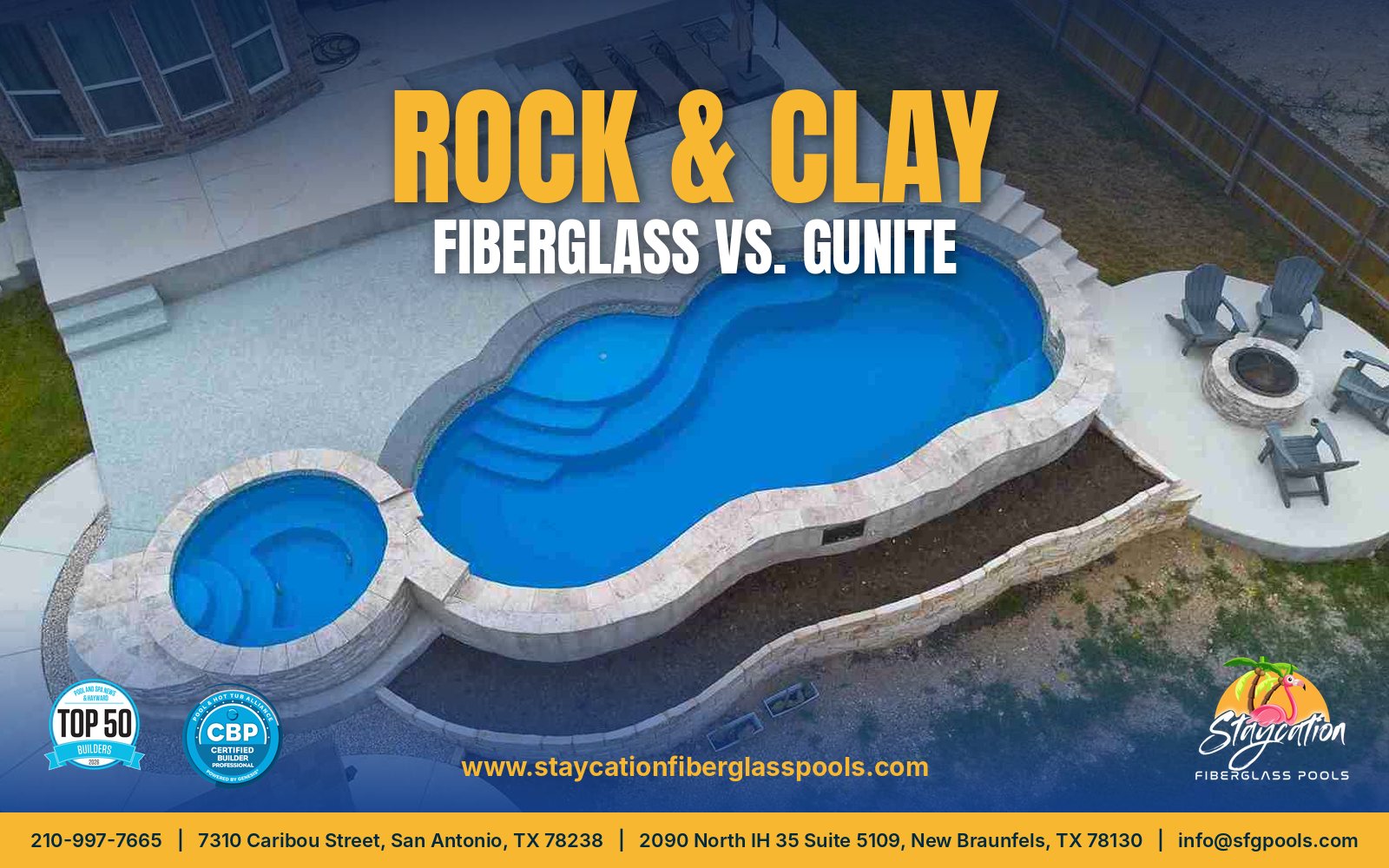
- Slopes are common. A hillside lot often needs retaining walls or a raised edge, like the spa in the photo above.
- Water moves through the rock. Water can collect around a pool after heavy rain, so drainage and a de-watering sump matter.
- Aquifer rules can apply. Parts of north Bexar and Comal counties lie over the Edwards Aquifer's recharge and contributing zones. TCEQ's Edwards Aquifer Protection Program regulates construction over the recharge, transition and contributing zones, and its map viewer shows whether a site falls inside a regulated zone.
Blackland clay: the ground that moves
East of the escarpment, the story is clay. Houston Black clay, the official state soil of Texas, covers about 1.5 million acres of the Blackland Prairie, which the Texas Water Development Board says stretches from north of Dallas south to San Antonio. The TWDB describes it as a soil that shrinks and swells markedly as its moisture changes, and notes that this very high shrink-swell potential commonly limits building sites.
The Texas Department of Licensing and Regulation calls expansive soils a very common cause of foundation problems, because the ground heaves when it's wet and settles when it dries. AQUA Magazine, a pool industry publication, notes that the main damage expansive clay causes around pools is deck heave, and that the forces involved can be enough to lift decking and even a pool shell.
How gunite pools are built
Gunite is a form of shotcrete, which the American Shotcrete Association describes as a method of placing concrete. The crew digs the hole, ties a cage of steel rebar in place and sprays concrete over it to form the shell on site. Plaster and tile go on after the concrete cures.
Because the shell is formed in your yard, gunite can take almost any shape. It is also a rigid structure. The Shotcrete Association notes that poor curing in hot or windy weather raises the risk of shrinkage and cracking, which is worth asking about in a South Texas summer. The plaster finish also wears over time. AQUA Magazine puts the life span of plaster on gunite pools at roughly 10 to 15 years before it needs resurfacing.
How fiberglass pools are built
A fiberglass pool is built layer by layer on a mold in a factory and arrives as one piece. The builder prepares the hole, sets the shell on a level base with a crane and backfills around it. The smooth gelcoat surface is part of the shell, so there is no plaster to replaster.
Manufacturers design fiberglass shells to flex slightly with the ground instead of standing completely rigid. One manufacturer describes its shells as able to adapt to minor ground shifts without developing structural cracks. That flexibility is helpful on moving clay, but it only works with the right support around the shell. If you want to dig deeper into the material itself, our page on why fiberglass covers the gelcoat, the shell and day-to-day care.
Installation matters more than the label
A good builder respects the ground, whichever pool you pick. On our installs, the shell is surrounded by crushed stone backfill, for firm, free-draining support. A composite rebar, 12-inch bond beam ties the top of the pool together, and a de-watering sump gives water a way out after a heavy rain. You can see each step on our advanced installation methods page.
The deck deserves the same attention. On clay, keeping water away from the pool and the slab matters as much as the shell itself. On rock, the plan for retaining walls and drainage shapes the whole backyard.
Questions to ask any pool builder
- What do you expect to find under my yard, and how will you dig it?
- What goes around the shell as backfill, and why?
- How will water drain away from the pool and the deck after a storm?
- Is my lot in a regulated Edwards Aquifer zone, and does my HOA need to review the plans?
Plan for the ground you have
Rock and clay don't rule out a beautiful pool. They just call for a plan made for your lot. We build on limestone hillsides in places like Boerne and Vintage Oaks, and on flatter lots across San Antonio and New Braunfels. If you're starting to plan for next summer, schedule a free consultation and we'll look at your site and talk through the options.
Frequently Asked Questions
Yes. Limestone close to the surface is common in the Hill Country, and many types of rock can be dug with normal equipment. Harder ledges may call for an excavator with a hydraulic hammer. We look at your site during the consultation and plan the dig for the ground we expect to find.
Both can be built on clay, but neither should be built carelessly. Shrink-swell clay moves rigid concrete, and fiberglass manufacturers design their shells to flex slightly with minor ground movement. With either type, good backfill, drainage that keeps water away from the pool and a well-built deck make the biggest difference.
The USDA's Web Soil Survey maps soil types for most addresses, and your home's foundation report or survey may also mention soil conditions. During your consultation we look at the site in person, because rock and clay can change from one side of a lot to the other.